

EBK Home
Kingdoms
Royalty
Saints
Pedigrees
Archaeology
King Arthur
Mail David

ATHERSTONE
Burial Place of Arthur-Arthun-Anwn-Andragathius?
The Tradition: Geoffrey of Monmouth and other medieval Arthurian writers tell us that Arthur was taken to the Isle of Avalon to be healed of his wounds after the Battle of Camlann. Later tradition assumed that he died and was buried there and identified the place as Glastonbury in Somerset.
 The
Theory & Discovery:
Blackett & Wilson
claim that one of the two figures who went to make up "King
Arthur" is to be identified with the Emperor Magnus
Maximus's son, King Anwn of South
Wales. This man, who occasionally may have spelt his name Arthun,
they identify with both the real King Arthur and the classical
Andragathius who fought for Maximus during his continental campaigns. In
searching for his burial-place, Blackett & Wilson claim that the
original Glastennen of Arthurian legend became confused with
Glastonbury in Somerset. Its original location was at an ancient cemetery
called the "Old Bury" near Atherstone in Warwickshire. The
village of Glascote stands nearby. They cite the Harleian MS 3859 Pedigree
No 25 as proof, by interpreting its last passage "funt glastenic qui
uenerunt que uocatur loyt coyt" as meaning that the people of Glastennen
lived at a place called Caer-Luit-Coyt, that is nearby Wall in
Staffordshire. Blackett & Wilson believe that the Warwickshire
Arthurian tradition became absorbed into the tales of the local hero, Guy
of Warwick. Final proof came with their apparent discovery of an ancient
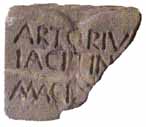
sub-Roman memorial stone at Old Bury bearing the partial inscription, Artoriu...Iacit
in...Maci... - possibly "Artorius lies here (son of) Maci(mus)".
Could Atherstone have taken its name from this very monument?
The
Theory & Discovery:
Blackett & Wilson
claim that one of the two figures who went to make up "King
Arthur" is to be identified with the Emperor Magnus
Maximus's son, King Anwn of South
Wales. This man, who occasionally may have spelt his name Arthun,
they identify with both the real King Arthur and the classical
Andragathius who fought for Maximus during his continental campaigns. In
searching for his burial-place, Blackett & Wilson claim that the
original Glastennen of Arthurian legend became confused with
Glastonbury in Somerset. Its original location was at an ancient cemetery
called the "Old Bury" near Atherstone in Warwickshire. The
village of Glascote stands nearby. They cite the Harleian MS 3859 Pedigree
No 25 as proof, by interpreting its last passage "funt glastenic qui
uenerunt que uocatur loyt coyt" as meaning that the people of Glastennen
lived at a place called Caer-Luit-Coyt, that is nearby Wall in
Staffordshire. Blackett & Wilson believe that the Warwickshire
Arthurian tradition became absorbed into the tales of the local hero, Guy
of Warwick. Final proof came with their apparent discovery of an ancient
sub-Roman memorial stone at Old Bury bearing the partial inscription, Artoriu...Iacit
in...Maci... - possibly "Artorius lies here (son of) Maci(mus)".
Could Atherstone have taken its name from this very monument?
Possible Interpretations & Criticism: The appearance of Arthurian themes in the tales of Guy of Warwick were first recognised by Edward Llwyd back in the early 18th century and the idea of an amalgam of such stories in the Midlands is not without merit. Key to Blackett & Wilson's argument, however, is their interpretation of the Harleian MS 3859 passage concerning Glastennen. Unfortunately, the usual translation indicates that the people of Caer-Luit-Coyt (Wall) relocated themselves to the Somerset Levels and this is backed up by old Glastonbury legends about the town's founder, Glast, who can be found in North Welsh border pedigrees. There therefore seems little reason to search for an alternative Glastonbury. The "Arthur Stone" has still to be examined by recognised academic authorities. Blackett & Wilson are actively seeking an independent scholar to undertake such a task; the results of which are eagerly awaited by the Arthurian research community.