|
|
|
|
|
 |
 |
|
||
|
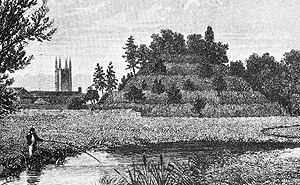 MARLBOROUGH MARLBOROUGHPublic Schools hides Merlin's Prison Merlin's Mount is in the grounds of Marlborough College, only a 100 yards off the A4, but partly concealed by the college chapel. It is freely accessible. In the grounds of Marlborough College stands a rather bizarre conical mound of grassed earth with a spiralling path all the way round. It is known locally as 'Merlin's Mount' or 'Merlin's Grave' for here the great wizard is supposed to have been buried (or perhaps imprisoned by the Lady of the Lake). Perhaps he chose this spot as his last resting place because of its religious significance. The sarsen stones of the largest circle at Stonehenge, which Merlin is said to have built, came from the Marlborough Downs. Whatever the circumstance, this famous burial mound or barrow later gave it's name to the town which grew up around it: 'Merlin's Barrow' becoming 'Marlborough'. The elaborate spiralling effect is part of a 17th century landscaping scheme, but in origin, the mound has always been known as the mote of a Norman Castle built in about 1110. It became a popular Royal stop-over point for hunting in Savernake Forest well into the reign of King Henry III. Yet, as early as 1215, a would-be Abbot of Cirencester recorded that the town was named after 'Merlin's Tumulus' and there has often been speculation that the mote replaced an earlier mound, perhaps a prehistoric religious spot like Silbury Hill. This was reinforced by the discovery of a number of Roman coins there and recent investigations have now confirmed that the mound does indeed date from 2,400 bc. It is the second largest prehistoric mound in Britain, perhaps Europe. Marlborough - or Merleberge in 1086 - is indeed accepted as meaning "Maerla's Hill"; but Maerla is almost certainly a shortened form of the name of a Saxon lord such as Maerheard, not a Celtic Druid. Presumably it became connected with Merlin because of both the name and the ancient religious associations. The Merlin-form of the Arthurian magician's name is first known from Geoffrey of Monmouth's writings of the 1130s. Before this the character was known by the Welsh name of Myrddin.
|
|
||
| © Nash Ford Publishing 2002. All Rights Reserved. | |
|||